
Homeschooling
Knowing and Being Known- Moving Beyond Anonymity
Family is called to be a place capable of taking man out of his anonymity — how homeschooling invites true connection and lets each person be seen.
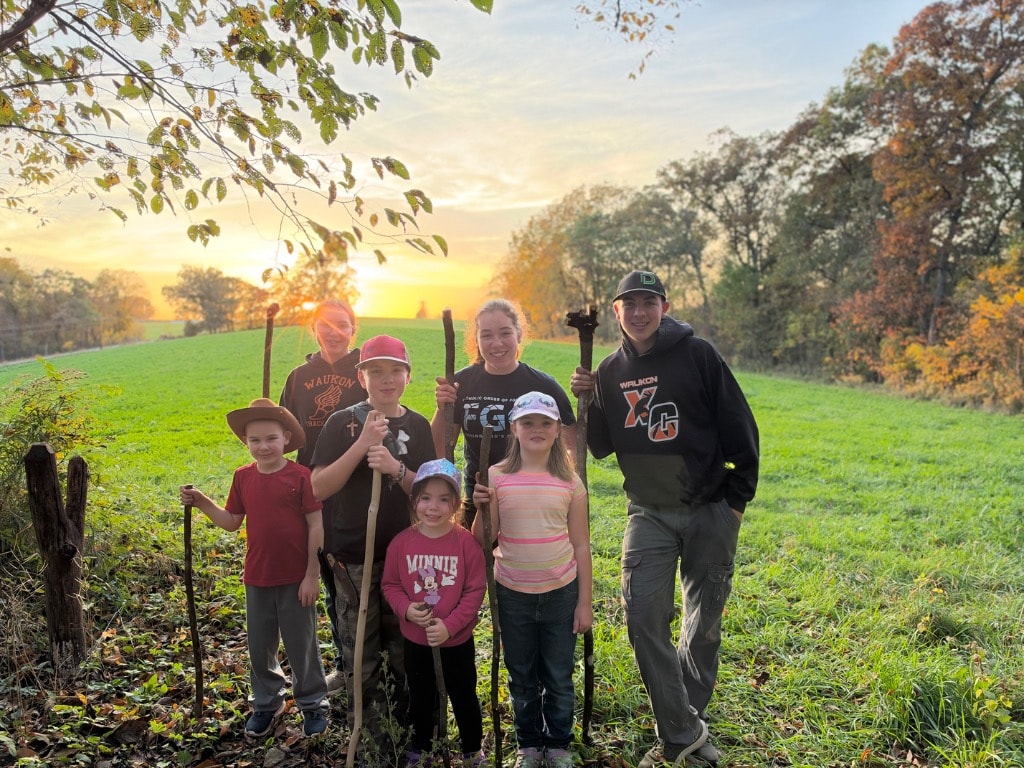
Many in our society today, particularly young people, are experiencing a lack of depth in both personal and social relationships. With the exponential rise of social media platforms, face to face, authentic interaction are at an all-time low. Additionally, according to family psychologist Dr. Ray Guarendi, where there is anonymity and disconnection, there is often lack of restraint leading to a warped sense of what is real. Despite the fact that people are constantly connected to Facebook, Twitter and Instagram, statistics repeatedly show that people are feeling increasingly disconnected, offering merely a counterfeit of deeper relationships.
In Pope John Paul the Great's Familiaris Consortio we read about the importance of family life as an experience of communion and sharing. In complete contrast with today's culture, family is called to be a place "capable of taking man out of his anonymity." Instead of removing him from society and making him feel alone or on his own, family actively places him, "in his uniqueness and unrepeatability, within the fabric of society."
Growing up, in my mind I always imagined myself in full-time ministry. I imagined I would schedule and cancel meetings and talk to people when I planned to. In my mind people knew me, but I would never let them close enough to know my failings. Let's just say God has completely turned my concept of "ministry" upside-down. In marriage I have found true, authentic love and acceptance in spite of my many mistakes, failing and lack. In parenting, I have found children that also love me, even on my worst days. They see it all— the beauty and the struggles. I am known. I am not hidden.
Homeschooling, by its very nature, invites true connection, allowing each individual to be seen. It allows for individualized attention, not a one-size fits all concept. According to John Paul II's encyclical, Gratissimam Sane, "Education is thus a unique process for which the mutual communion of persons has immense importance."
By in large, homeschooling is a far more natural environment for kids to learn in. Homeschooling prepares students for real life interaction by surrounding them not just with children their own age which creates almost an echo chamber effect, but the young and the old. In Familiaris Consortio, we read, "…the family is the first and irreplaceable school of social life, and example and stimulus for the broader community relationships marked by respect, justice, dialogue and love." Aristotle is quoted as saying, "Friendship requires some kind of common life." In order for children to form strong bonds with their parents and siblings, they have to live together and spend time together. If most of their time is spent away at school, with other children and teachers, their strongest bonds will naturally be with them. Homeschooled students will be naturally surrounded by a variety of ages, both young and old, allowing them to appreciate the uniqueness of all those around them.
When I look at the ministry of Jesus, He surrounded Himself very closely with His 12 beloved disciples. They lived with him. They saw him when He was tired and when He was hungry. They saw how people loved him and rejected Him and His response. And most importantly, they were known by Him. He knew their idiosyncrasies, the things that made them light up, the things that made them frustrated, and their chronic struggles. He loved them and extended mercy to them. They were seen by Him. Ordinary men, pulled out of their anonymity, ended up being used by God to radically change the world.
References:
- Guarendi, Ray. Raising Upright Kids in an Upside-Down World. Irondale, AL: EWTN Publishing, Inc., 2019.
- Pope John Paul II, The Role of the Christian Family in the Modern World, Familiaris Consortio, (22 November 1981), §43.
- Laura Berquist, "Why Homeschool When There is a Good School Down the Road?", at families.modg.org